Menu Close

Uncategorized

Goodbye, old friend

I’ve been holding off on writing about this because it makes me sad.

About a week ago, I was driving home from work, and I noticed that my car was making sort of a clicking noise, and it wasn’t accelerating very well. It was also idling really badly. Mark and I were leaving town that night, so I didn’t think much about it until Monday morning, when I took it into the mechanic. He told me the engine was “just about shot” and didn’t really elaborate, but charged my ninety bucks for the diagnosis. So I then took it to the good mechanic (the one I should have taken it to first), who took only a few minutes to tell me (at no charge) that I had a burned out valve, and that replacing it would cost eight or nine hundred dollars.

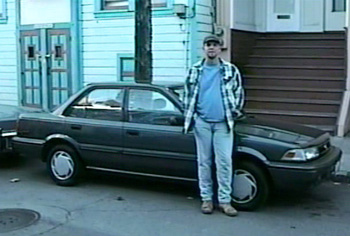
My car is a 1991 Toyota Corolla, with 175,000 miles on the odometer, peeling paint on the exterior, a broken key stuck in one of the doors, and bad shocks. Some of you may remember when I bought it, over eleven years ago, following its predecessor’s disturbing death by arson. I love this car. It’s taken me on two round trip cross-country journeys (one in 1997 and one in 1998) and another one-way crossing as well. It survived numerous break-ins in San Francisco, and took me to Fresno and back many weekends in 2001 and 2002, before Mark and I cohabited. We’ve been everywhere together, and it’s given me almost no trouble at all, aside from a big scare which turned out to be a minor thing in central Texas in 2005. I thought it was indesctructable. But it’s not. And I can’t justify spending so much money (probably more than its current book value) on this repair.

Which means that my Corolla is about to go to car heaven. Its tags and insurance (conveniently coming due on the next month or so) will not be renewed. I’m going to run out its last tank of gas (I filled up the day before the calamity) driving back and forth to work, since I’m comfortable walking home from there should it die on the road. And then, I’ll either scrap it or donate its carcass to a worthy cause and take a tax deduction.

I drive my cars until they die. I’m glad this one didn’t die a slow, lingering death like my Firebird and my Duster, nor a violent death like my Scamp, my Tempo, and my Cavalier. I’d like to go that way myself when my time comes.

I’m really going to miss this car. I’ll probably never have another one that will compare.

I-280 reopens

On 29 April 1993, Interstate 280 between Mariposa Street and US 101 reopened, if in a somewhat limited capacity, following the 1989 Loma Prieta earthquake:

From the San Francisco Chronicle (30 April 1993):

Part of I- 280 Shut by Quake Finally Opens – One lane each way in link to downtown S.F.

Author: Clarence Johnson, Chronicle Staff Writer

Three and half years after the Loma Prieta earthquake, a closed section of Interstate 280 partially reopened yesterday, allowing a trickle of traffic to reach a downtown flank of San Francisco and points south.

Believing that a little something is better than nothing, jubilant California Department of Transportation officials announced the opening of one lane in each direction on the two-tier viaduct that was closed after being rattled by the October 1989 temblor.

Cars can now travel I- 280 in both directions from Daly City to the Sixth Street off-ramp. But motorists will still have to exit I- 280 and use city streets to reach Highway 101 South from San Francisco.

Still, there were smiles, handshakes and sighs of relief from Mayor Frank Jordan and state Senator Quentin Kopp, independent- San Francisco, who put on hard hats and helped highway engineers pull aside orange-and-white-striped barriers to let the traffic roll again.

“We feel we have made major inroads by now having at least two (lanes) open ,” Jordan said. He said the restored freeway may help merchants in Chinatown and North Beach who claim business has lagged since the quake. “This is a major artery. It’s a relief for me because I have literally gotten thousands of phone calls from people wanting to know what is the time line for reopening this,” the mayor said.

The partial opening represents completion of about one-third of the reconstruction job along the 1.6-mile stretch of freeway. The opening comes after numerous delays that put the $140 million project more than 16 months behind schedule.

Total reconstruction will require replacing 125 support columns, shoring up an unsteady foundation and rebuilding cracked joints.

Yesterday’s opening actually came a month ahead of the last scheduled deadline.

The hurried work pace was also attributed in part to Kopp, who pushed Caltrans for results.

“This is testimony to patience and courage and, I suppose, some political persistence,” said Kopp, who is chairman of the Senate Transportation Committee. “This is an enormous engineering accomplishment. But I have to say after I lost my patience, the director of Caltrans stepped in and personally made this one of his projects.”

Caltrans officials, smarting from criticism that they underestimated the damage and then set unrealistic timetables for the completion of work, were cautious yesterday when asked when the rest of the job will be done.

“We’re getting there,” said Caltrans district director Preston Kelley. “By the end of the year I hope to tell you when we’ll have additional traffic on this road. And when we give that date, we certainly hope we will be able to keep it.”

When fully functioning, the freeway runs three lanes in each direction, allowing about 95,000 cars daily into and out of the city. The two lanes opened yesterday will probably carry about 25,000 cars a day, transportation officials said.

“It’s definitely not the final solution but it’s a start,” said Caltrans spokesman Colin Jones. “The whole idea is not just to fix it but to strengthen it.”

Jones said the rebuilt portion would now endure an earthquake measuring up to 8.3 on the Richter scale. The 1989 quake measured 7.1.

Some damage along the double-deck I- 280 roadway resembles the Embarcadero Freeway, which was so badly damaged in the earthquake that it was torn down. Another look-alike freeway, the Cypress structure in Oakland, collapsed during the quake, killing 47 people.

I- 280 reportedly rocked so viciously during the quake that sections of the viaduct slammed into each other, cracking off pieces.

“Some columns actually fractured so you could see the reinforcing steel in places where the concrete had just disintegrated,” said project engineer Ken Bunker. “The damage was impressive.”

Initially, Caltrans engineers thought the freeway could be reopened within a few months after temporary repairs were made. The least-damaged section, between 25th and Sixth streets, reopened after a brief closure.

But a special review panel of engineers from the University of California at Berkeley and at San Diego recommended extensive repairs to guarantee that the freeway would survive a 8.3-magnitude earthquake, Jones said.

The reopening can come none too soon for Rob Rossi, owner of the Flower Market Restaurant at the foot of the freeway on Sixth Street. He said his and other businesses in the area have been flat since the freeway closed.

“Business has been steady, not growing by 10 to 15 percent like it should have been,” said Rossi. “This used to be my own private driveway. Coming from Daly City it took seven or eight minutes to get here. Now, if you miss-time it, it can take you an hour.

“It’s inadequate,” said Rossi referring to the two new open lanes. “It’s not what it should be. But I guess they want to get something rolling. There’s been a lot of lost trade.”

At the time, I was living South of Market and driving to work near Stonestown Galleria in the Sunset. I was ecstatic.
At a crossroads

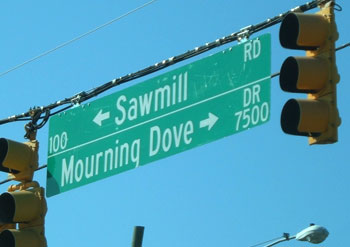
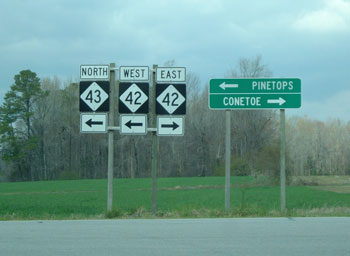
At certain points in life, one finds oneself at a crossroads. I found myself at this one over the past weekend. There’s no real significance here, and nothing that will explain my two week absence. I was just amused to have found myself midway between Pinetops and Conetoe.

My cool activity for the day was seeing this guy speak, which gave me a bigtime geek stiffy. I rememeber being really excited about this project when I read about it in the Chronicle several years ago and then, for some reason, forgetting all about it. I think I originally had trouble accessing the site and then sort of forgot to go back to it. Anyway, this is very sexy stuff, and it’s sort of the whole reason I got on this whole Library and Information Studies kick and entered graduate school at age 43.

So how was your spring break?

Rock and roll queer bars

The South of Market area was a pleasant enough place to drink (or debauch) for much of the 1990s, particularly if you were a Sodomite looking for a scene that was a little less antiseptic and generic than the Castro. Following ten years of AIDS paranoia in the 1980s, the final decade of the twentieth century brought a return to openness about sex and a renewed vigor to South of Market nightlife.

The really great thing about the 1990s, though, was that the universal soundtrack did not consist solely of the same stale old disco divas and other “high NRG” dance tracks that had defined (defamed?) the term “queer bar” seemingly since the dawn of time.

Starting with the Lone Star Saloon — which was, incidentally and accidentally, the first queer bar your humble host ever visited in San Francisco — there was actually music featuring guitars being played in South of Market nightspots.

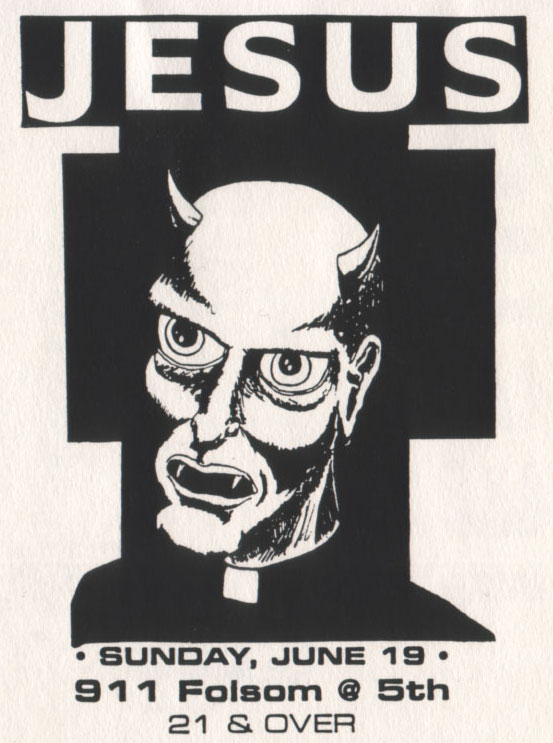
There had been other rock and roll or “alternative” theme nights, of course, including Junk (one of my favorites) and Jesus at The Stud, and one whose name I can’t recall at some club in Upper Haight. And Michael Pandolfi had done some semi-regular sets at Detour in the Castro. But the Lone Star was the first queer bar in San Francisco to look at the genre as a regular everyday format.

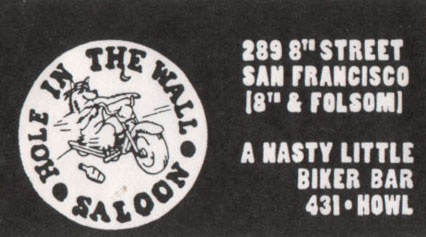
And on 15 April 1994, the Lone Star’s stepchild opened its doors at Eighth and Harrison as the appropriately-named Hole in the Wall Saloon. This tiny bar, which had formerly been a nondescript joint called The Borderline, was soon to redefine nightlife south of the slot with live DJs spinning rock and roll, and an attitude to match. It started slow, and early on, it was possible to find yourself surrounded ny maybe no more than a dozen other patrons on a Friday night. But by 1996, there were lines out the door every weekend. Too many of those waiting in line, alas, were slumming yuppies of the “see and be seen” variety who just didn’t get the concept. All the same, I had a lot of very interesting and very intoxicated nights there. Of course, it helped that my roommate was a bartender.

Eventually, the owners of Hole in the Wall also took over the SF Eagle, finally ridding the famed leather bar of its dreary lineup of bad, muffled dance covers (did the world really need a disco remake of “Smells Like Teen Spirit”?). In the new space, they even hosted live bands on occasion, while both bars had live DJs most nights. My Place, which was more notorious for sex than rock and roll, also got into the act on certain nights when the right bartenders were working.

My Place is gone now, but as far as I know, the other three bars are still plugging along, although things never seemed quite the same after the gentrification of the late 1990s. The Lone Star moved more toward the whole generic bear bar thing, and was playing a disturbing amount of country music when I stopped caring about 2001. And I read of some controversy over a potential relocation of the Hole in the Wall Saloon last year, but I’m not sure if anything came of it or if the relocation ever happened. To be honest, I’m 3000 miles, and many years, away from all that now, and I don’t really care too much anymore. Heck, I don’t even drink anymore.

Cool photo

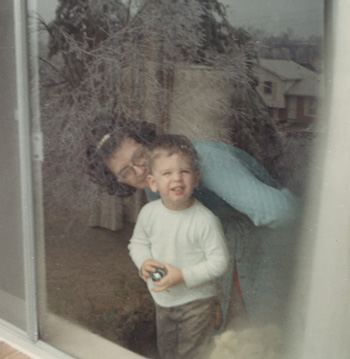
I was scanning some old photos today and I found this one. I just thought it was kind of cool, what with the reflection and the fact that it has that whole mid-1960s muted color pallette, like an ad in Life Magazine or a movie about suburban housewives.

I assume my dad took it with the trusty Instamatic. I’ll have to ask him.

The old mill

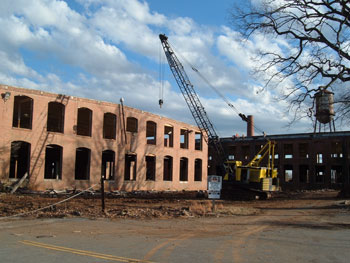
This was a pretty sad sight I wasn’t really expecting to see today. They’re tearing down the old Pomona Mill in Greensboro. This was less than two miles from the house where I grew up, so it’s a landmark I used to pass pretty much every day, and one that I’ll definitely miss.

By the time I was born, the building was being used as a Western Electric plant. By the time I was in high school, it had been converted into an outlet mall that never quite took off; that closed probably ten to fifteen years ago. The building had pretty much been vacant since then, I believe.

As far as I can tell, there aren’t any plans for the land. It’s in sort of an awkward location which isn’t really appropriate for retail, and the surrounding neighborhood isn’t sufficiently picturesque for it to be converted into lofts for the “faux urban” crowd. I imagine they’re tearing it down because they think the land may sell quicker that way, and they’re probably right.

All the same, I can’t imagine what they might build in its place, and I’m sure going to miss my old mill.

Sunset People

My first job in San Francisco was at a Kinko’s location adjacent to Stonestown Mall in the Sunset District. I’d transferred there from my old store in North Carolina, and it seemed a good way to get on my feet. Working in the Sunset also gave me a perspective on San Francisco not experienced by most young newcomers who arrive looking for that whole “urban thing.”

The Sunset is a strange hybrid of urban and suburban on the southwest side of San Francisco. Parts of it, most of them closer in and referred to as the “Inner Sunset,” developed from 1900 to 1920, but a large part of the area dates from after World War II. Unlike the crowded areas east of Twin Peaks, where rowhouses and apartment buildings are the standard mode of housing, single-family detached structures predominate in most of the Sunset. Thus, the area tends to be more family-oriented and somewhat more conservative than the rest of the city. The growing Asian population in the area has not changed this tendency at all.

Most “downtowners” view the Sunset as alien territory, full of everything they fled Des Moines or Houston or Raleigh to escape. Of course, they also have no real idea what they’re talking about, since most of them have never spent any appreciable time in the Sunset, nor the Outer Mission. Many folks whole live west of Twin Peaks and north of Bernal Heights don’t get out much, and it shows; they’re convinced that anything outside their little 15-20 square mile area is full of nothing but Wal-Mart stores and gun-toting Klansmen.

I got to know the Sunset fairly well during my years in San Francisco, starting from a strong foundation built while working at that Kinko’s branch. I’ll admit that it was a bit of a culture shock to move between the somewhat more sedate world of the Sunset and my South of Market home world of bars and sex clubs and live music and general chaos. The first thing I noticed was th fog, which I, of course, loved. Then I noticed that there were actually children and old people around; everyone wasn’t somewhere between 20 and 35. People in the Sunset had houses and jobs and drove cars, and didn’t brag about having managed to qualify food stamps like several trendoids I met South odf market did. People shopped at the Emporium or in Daly City rather than at trendy little overpriced boutiques, and there were actually supermarkets other than Safeway or Cala.

I didn’t particularly want to live there; my take was that the Sunset had too many of the negatives of both urban and suburban living and too few of the positives. For example, it was almost as expensive as more central parts of San Francisco, but generally lacked the pedestrian scale, neighborhood stores, etc. And I still think that’s true of many of its neighborhoods, although I later came to be very find of both the West Portal and Irving Street areas, not to mention the full length of Taraval Street. Interestingly enough, these also happen to be the only major transit corridors in the Sunset.

But I found the people I met there to be an interesting, if slightly quirky bunch. The Sunset has a much higher proportion of native San Franciscans (or at least it did in the early 1990s) and I noticed that many felt surprisingly little connection the the city. One of my coworkers, a 20-year-old who was born and raised in the Sunset, regularly went to San Jose for nightlife, saying there was “nothing for me to do in San Francicso.” And it’s true, I guess. He was black, heterosexual, not into the whole technohousedance thing nor the fashion scene, and I imagine he probably would’ve felt rather out of place in San Francisco’s over-hyped and overpriced clubs.

Compared to “downtown” San Francisco, the Sunset is less white, less transient, less fashionable, less gay, more politically moderate, and more diverse with respect to age (and increasingly even ethinicity). It’s not a bad place. It’s a pity more San Franciscans have never visited it. I’m glad I did.